
You know that feeling when you’re lying in bed, the room is quiet, but your mind is halfway across the world or three years into a future that doesn't exist yet? Maybe you’re winning an argument you’ll never actually have. Or perhaps you’re finally living in that tiny cottage by the sea, the one where all your problems have conveniently evaporated.
Yeah. That feeling.
We all do it. It’s the human superpower, imagination. We can take our minds anywhere. We can build worlds, solve problems before they happen, and find comfort when things get heavy. But lately, I’ve been thinking a lot about the direction that compass is pointing. Because if we aren't careful, imagination can stop being a tool for growth and start becoming an elaborate escape hatch.
The Lure of the Escape Hatch
It’s easy to get lost in the "what ifs." Sometimes, "what if" is a beautiful playground. We imagine the career shift, the new city, or the version of ourselves that is finally, truly at peace. It feels good. It’s like a mental vacation from a reality that might feel a bit too loud or a bit too stuck.
But there’s a trap here. I’ve fallen into it more times than I’d like to admit.
I used to spend hours imagining a life where I was perfectly organized, effortlessly productive, and never felt a lick of anxiety. I would dream about it in such detail that for a moment, it felt like I was actually doing something. But then I’d blink, and the laundry was still unfolded, the emails were still unanswered, and I was still… well, me.

We’ve gotten really weird about fantasy. We treat it as harmless, but when we use it to avoid the discomfort of our real lives, it becomes a way of staying stuck. It’s imagination used to mask the necessity to act. It’s dreaming without doing. And while it feels like a relief in the moment, it often leaves us feeling more disconnected when we eventually have to "land" back in reality.
When Worry Masquerades as Responsibility
On the flip side, imagination has a darker twin: catastrophizing. This is when our imagination points directly at everything that could go wrong. We paint the world black just by thinking about it.
We tell ourselves we’re "preparing." We’re "anticipating obstacles." We’re "being responsible."
But let’s be honest. Most of the time, we’re just suffering in advance for things that haven't happened yet. We use our incredible capacity for mental simulation to build a prison of anxiety. We’ve all been there: running through the worst-case scenario until our heart is racing and our palms are sweaty, all while sitting perfectly safe on our couch.
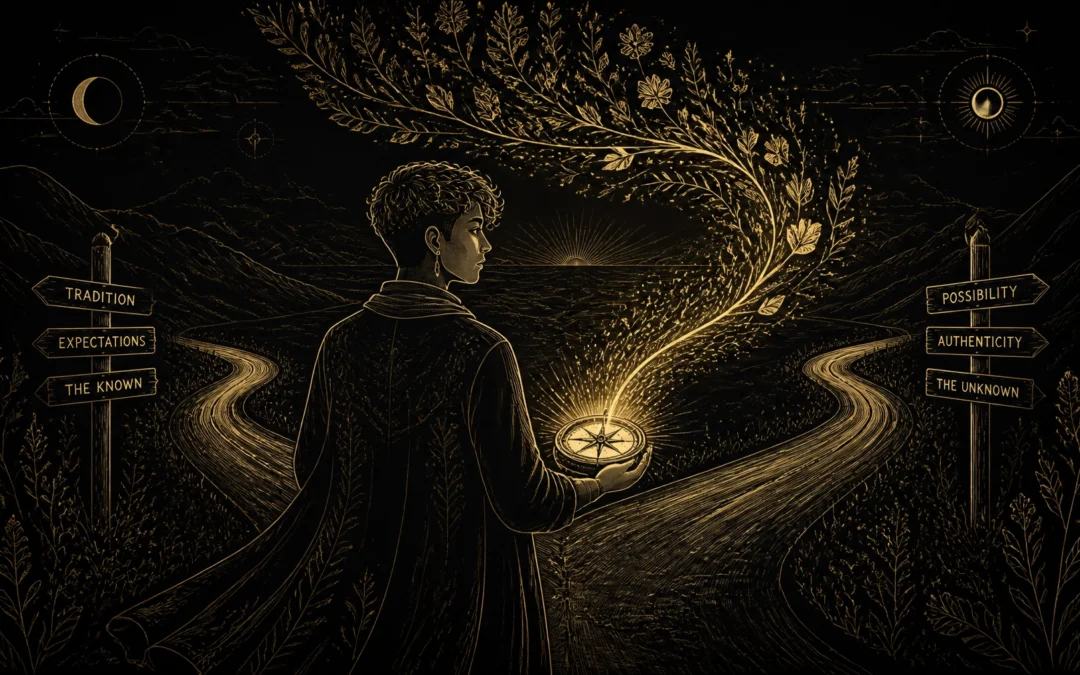
What if we treated imagination as a compass, not a destination?
If the compass is pointing toward a fantasy that makes us hate our real life, we’re off track. If it’s pointing toward a disaster that paralyzes us, we’re off track. The goal isn't to stop imagining: it's to point it toward growth.
The Turning Point: Imagination as Mental Rehearsal
There was a moment for me when the "unlearning" started. I realized that my imagination could be a bridge rather than a wall. Instead of using it to hide from the things I was afraid of, I started using it to practice them.
Psychologists call this goal-directed imagination or mental rehearsal. It’s the difference between imagining a perfect future and imagining yourself taking a specific, difficult step toward it.

Instead of just dreaming about a more peaceful life, what if we imagined ourselves setting a boundary with a difficult family member? What if we walked through the conversation in our mind, felt the discomfort, and imagined ourselves staying grounded through it?
That’s imagination linked to reality. That’s using the compass to find a path through the woods, not just to dream about being on the other side.
Turning the Compass: A Few Thought Experiments
If you’re feeling like your imagination has been taking you on too many unwanted trips lately, here are a few ways we can collectively try to steer it back:
- Check the "Reality Link": When you find yourself in a daydream, ask: Does this lead to an action I can take today? Even a tiny one. If not, it might just be an escape.
- Imagine the Obstacle, Not Just the Win: Most of us only imagine the trophy at the end. Try imagining the middle part: the messy, uncomfortable part where you’re tired but you keep going. It builds resilience instead of just a temporary high.
- The "Five-Minute Future": Instead of imagining three years from now, try imagining the next five minutes. Imagine yourself standing up, taking a deep breath, and doing the one thing you’ve been avoiding.
- Acknowledge the "Why": Sometimes we escape into imagination because our current reality doesn't feel safe. That’s okay. Be gentle with yourself. But maybe the imagination can be used to ask: What is one small thing I can do to make my current reality feel just 1% safer?
Grounding in the Now
At the end of the day, imagination is a beautiful, messy, human thing. It’s what allows us to write books, build companies, and maybe even get better at being human.
But the compass only works if we’re actually holding it while standing on the ground.

When the mental chatter gets too loud or the fantasies get too distracting, sometimes the best thing we can do is drop the compass for a second and just feel the weight of our own bodies. We can try a simple grounding practice to remind ourselves that reality, as flawed and un-organized as it is, is the only place where growth actually happens.
We’re all fellow travelers on this one. We’re all learning how to navigate the space between who we are and who we imagine we could be. It’s not about being perfect or never escaping into a daydream. It’s just about noticing where we’re headed and choosing, every so often, to point the compass back toward the messy, beautiful work of living.

Small steps. Slow progress.
We’re allowed to dream, but we’re also allowed to be right here, exactly as we are.